
The Countess diagnosed or ruled out cancer within 28 days for 86% of patients in June, against 79% across England. It fell two patients short on 31 days.
The Countess of Chester Hospital gave 86% of urgently referred patients a cancer diagnosis or the all-clear within 28 days in June. That is its highest monthly figure since at least April 2025, and seven percentage points ahead of England.
The number comes from NHS England’s provider-level cancer waiting times data, published in August and still marked provisional. It records 1,381 of 1,605 pathways at the trust completed inside 28 days. Across all providers in England the figure was 232,400 of 294,350, or 79.0%.
Nine months earlier the same trust was at 70.6%, and below the England average.
Three standards, and the Countess meets two of them
Since October 2023 there have been three cancer waiting times standards. Here is how the Countess did against each in June 2026:
| Standard | Countess | England | Threshold |
|---|---|---|---|
| Faster Diagnosis, 28 days | 86.0% | 79.0% | 75% |
| Treatment within 31 days of a decision to treat | 95.3% | 92.2% | 96% |
| Treatment within 62 days of urgent referral | 82.9% | 69.9% | 85% |
The 28-day standard is cleared comfortably. So is the improvement objective of 80% that NHS England set for March 2026.
The 31-day standard is the one it missed, and it missed it narrowly. The trust treated 162 of 170 patients within 31 days of the decision to treat. To reach 96% it needed 164. Two patients separated it from the target.
The 62-day standard is the hardest in the system and almost nobody meets it. The Countess did not either, at 82.9% against a threshold of 85%. But that is 13 percentage points above the England figure of 69.9%, and above the 75% NHS England set as its own objective for March 2026.
Where that puts it nationally
Among NHS trusts with at least 50 pathways in the month, the Countess ranked:
- 14th of 122 on the 28-day Faster Diagnosis Standard
- 17th of 120 on the 62-day standard
Those ranks are our own count from the NHS England file, restricted to organisations with “NHS” in their name so that private diagnostic companies do not crowd the table. Several of those firms post higher percentages, but they run narrower services.
One quirk of the data is worth explaining, because it looks like an error. The 62-day totals come out in halves: 133 of 160.5 pathways at the Countess. That is deliberate. When a patient’s pathway is shared between two trusts, each is credited with half of it.
The climb since last autumn
The trust’s 28-day performance dipped through the summer of 2025, bottoming out at 70.6% in September when the England figure was 73.8%. It has been above the national average every month since October 2025.
| Month | Countess | England |
|---|---|---|
| July 2025 | 71.3% | 76.5% |
| August 2025 | 73.3% | 74.6% |
| September 2025 | 70.6% | 73.8% |
| October 2025 | 77.9% | 76.1% |
| November 2025 | 78.7% | 76.5% |
| December 2025 | 80.3% | 77.4% |
| January 2026 | 74.7% | 72.8% |
| February 2026 | 83.8% | 80.5% |
| March 2026 | 85.6% | 79.4% |
| April 2026 | 82.8% | 75.9% |
| May 2026 | 84.3% | 79.0% |
| June 2026 | 86.0% | 79.0% |
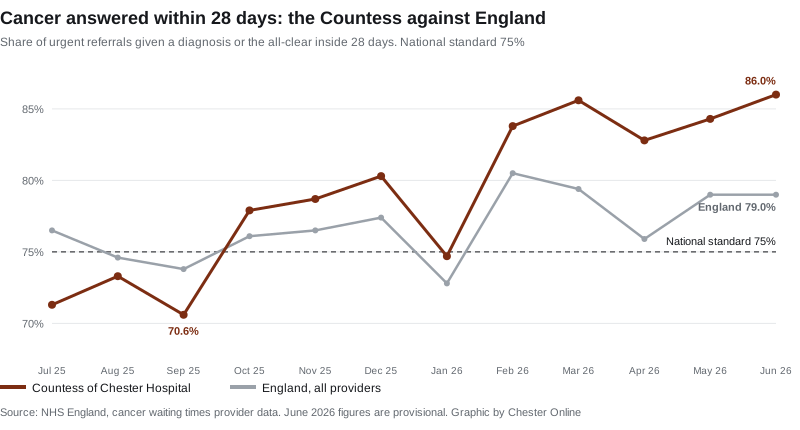
January is the dip both lines share, which is what a winter usually does to NHS performance data. What is not shared is the gap that opened afterwards.
Demand rose over the same period. The trust logged 1,350 urgent suspected cancer referrals in April, 1,459 in May and 1,674 in June. The June figure is the highest of the three, and performance improved anyway.
What the hospital says it changed
The trust’s own account credits endoscopy. In a statement on its website, the Countess says it was named best in England for quickly diagnosing lower gastrointestinal cancers, the group that includes bowel cancer, for four months in a row. The statement carries no date, and its most recent figure is from July 2025, so treat it as an account of how the improvement was made rather than as this month’s news.
Its figures for that pathway are stark. In April 2023, “only 31 out of every 100 patients got their results within four weeks”. By July 2025 it was 93 in 100.
The trust says its endoscopy service now aims to book patients for their procedure within two weeks of the request being made, rather than letting the booking itself absorb the 28-day window.
Pippa Scott-Heale, divisional director of planned care, said: “This success is thanks to the incredible efforts of our diagnostics, gastroenterology and cancer care teams, who have worked tirelessly to improve how quickly patients are seen and supported.”
She added that being named best in England for quick bowel cancer diagnosis was “a big moment, especially given where we were just two years ago on this, and the long-standing challenges we’ve faced”.
What it means for you
- If your GP refers you urgently, the 28-day clock starts at the referral, not at your first appointment. It ends when you are told either that you have cancer or that you do not. At the Countess in June, roughly six in seven people got that answer inside four weeks.
- If you are told you need treatment, the 31-day clock starts at the decision to treat. The trust was close to the 96% standard rather than at it, so a small number of patients still waited longer.
- The 62-day measure is the one to watch. It covers the whole journey from urgent referral to first treatment, and it is where the national picture is worst. The Countess is well ahead of the England figure but has not reached the 85% standard.
- These figures are provisional. NHS England revises them when trusts resubmit, so June’s numbers can move slightly before they are finalised.
- Getting there: the PR3 park and ride from Upton serves the Countess of Chester Hospital and the university, and there is a £1.50 Countess ticket valid on that route between Upton and Liverpool Road. Details are on our parking in Chester page, and September’s engineering work is on the roadworks and travel page.
The trust serves Chester, Ellesmere Port and a large part of north east Wales, so the figures above cover a catchment well beyond the city.
Sources
- NHS England, cancer waiting times statistics, 2026-27 April to June monthly combined provisional file, and the 2025-26 April to September final and October to March provisional files (all provider-level figures, England totals, referral counts and the national rankings in this article are calculated from those files)
- NHS England, cancer waiting times standards from October 2023 (the 75%, 96% and 85% thresholds)
- NHS England, cancer programme update (the 80% Faster Diagnosis and 62-day improvement objectives)
- Countess of Chester Hospital NHS Foundation Trust, Countess of Chester Hospital leads England in faster cancer diagnosis (the lower gastrointestinal figures, the endoscopy booking target and the quotations)
Have your say